

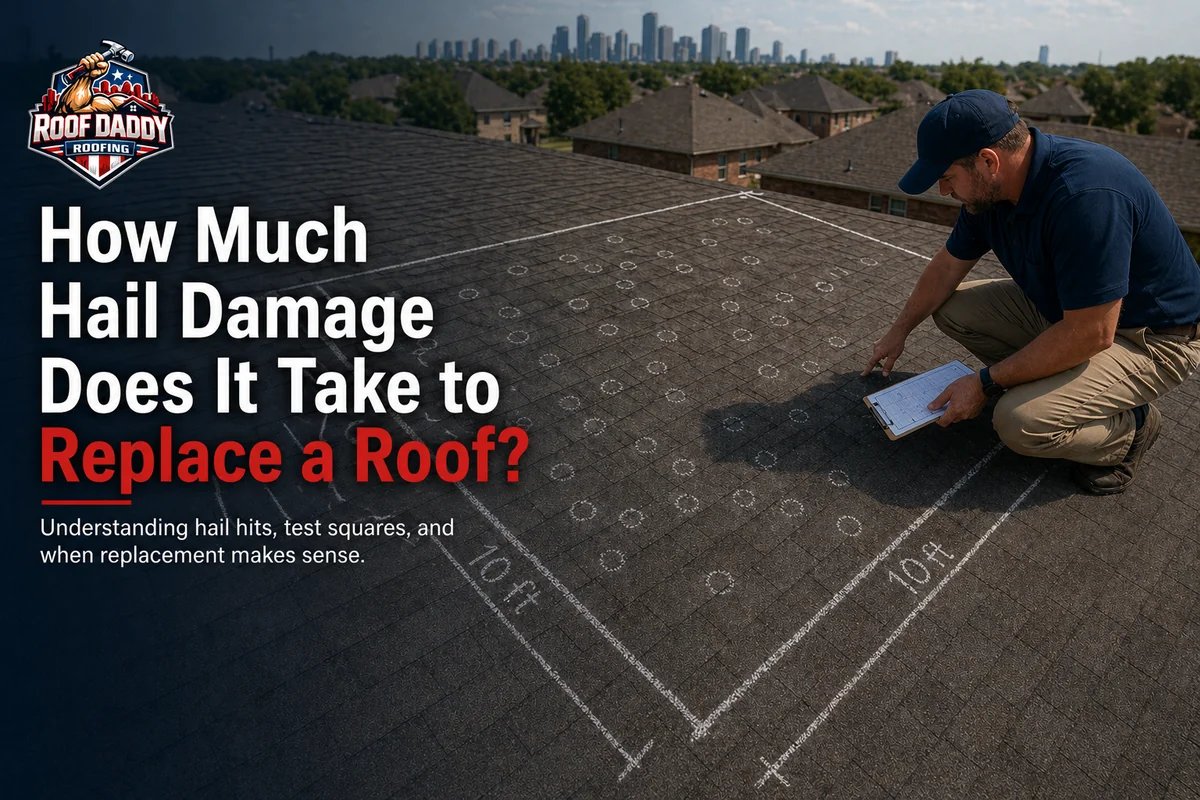
How Much Hail Damage Does It Take to Replace a Roof?
Insurance adjusters use hit-count thresholds on 10x10-foot test squares to approve roof replacements, and knowing those standards before your inspection can make or break your claim.


How much hail damage does it take to replace a roof is not a question with a vague answer. Insurance adjusters use specific, documented field criteria to decide whether your roof gets a full replacement or a patch. Knowing those criteria before your adjuster shows up can be the difference between a fully covered replacement and a $10,000 out-of-pocket surprise.
What Is a Test Square and Why Does Every Claim Start With One?
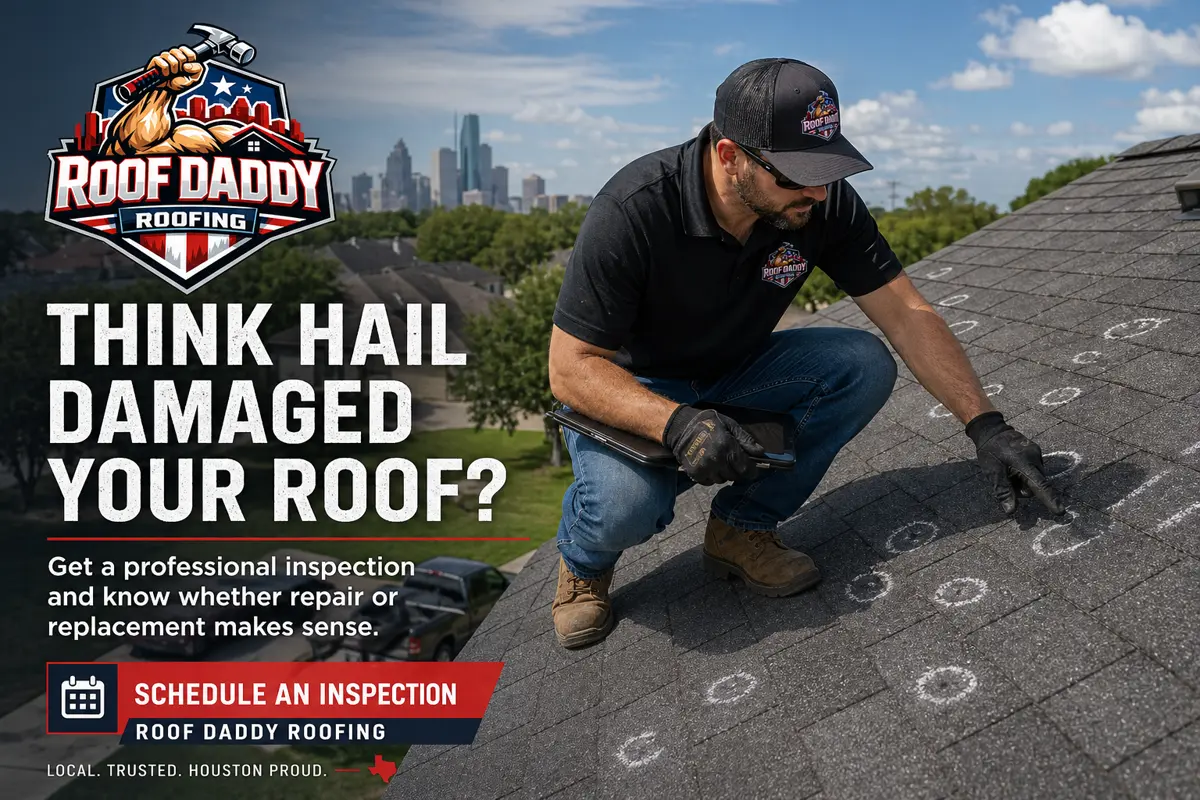
A test square is a 10-by-10-foot section of your roof, 100 square feet of shingle surface, that an adjuster marks off and examines for hail impacts. The number of qualifying hits within that square determines whether the damage meets the carrier's threshold for replacement coverage.
Most major insurance carriers require at least 6 to 8 functional hits per test square to approve a full replacement on standard asphalt shingles. A functional hit is one that causes measurable physical damage: a dented tab, a bruise that crushes the fiberglass mat below the surface, or a cracked tab that compromises waterproofing. Cosmetic dents that leave the shingle structurally intact typically do not count toward the threshold.
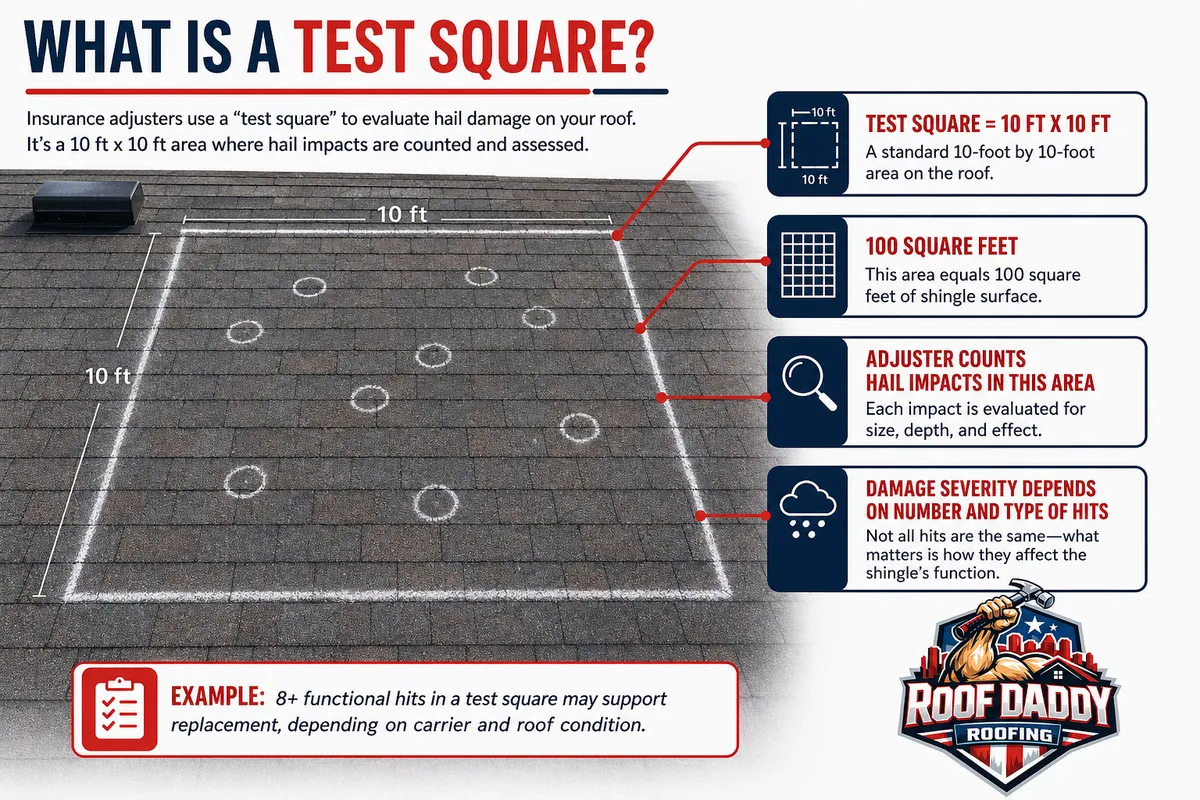
Adjusters typically examine multiple test squares across all slopes of the roof, front, back, and both sides. A roof with consistent damage across several squares presents a much stronger case for full replacement. A roof where only the north-facing slope shows concentration of hits might result in a partial repair recommendation.
Understanding this framework helps you have a more informed conversation with your adjuster and know when the math supports a full replacement.
What Counts as a Functional Hail Hit?
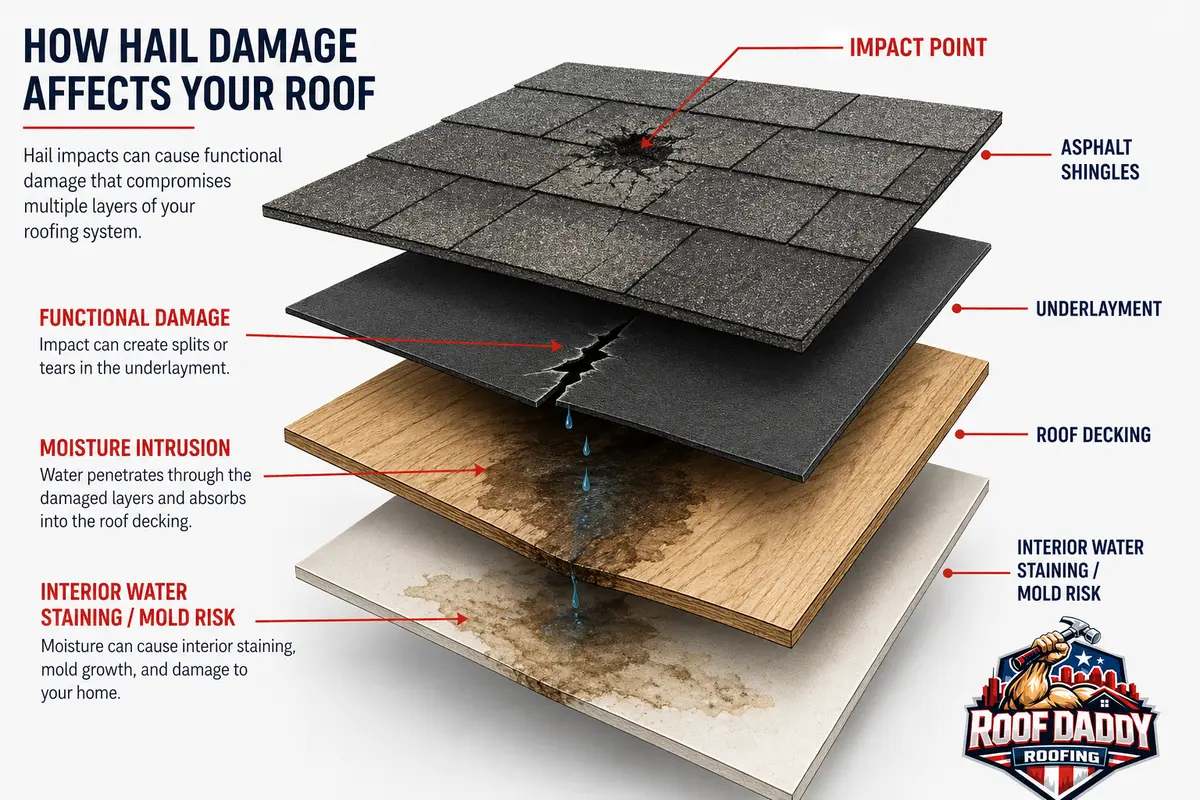
Functional damage is any impact that compromises the shingle's ability to protect your home from water intrusion. Signs that typically count toward replacement thresholds include:
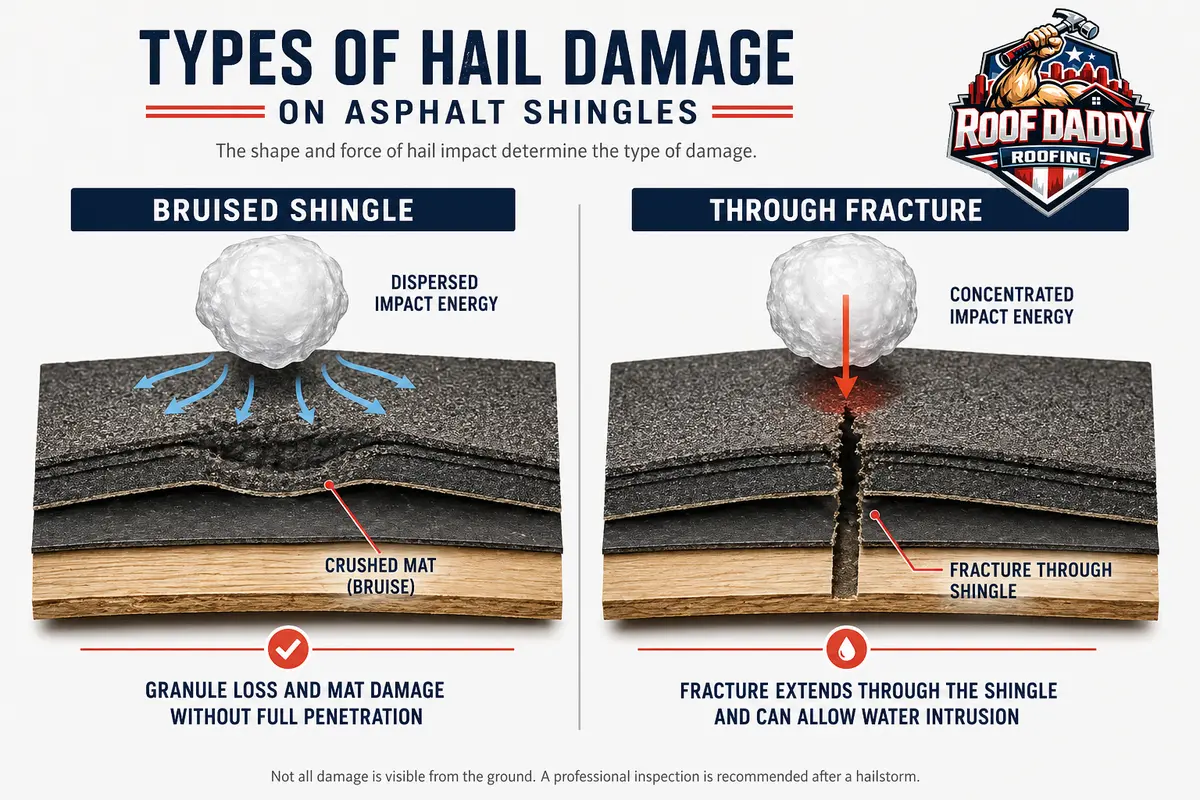
Cosmetic damage alone, such as surface granule displacement that leaves no mat exposure and no structural compromise, does not typically meet most carriers' definition of functional damage. This is where disputes between homeowners and adjusters most often arise.
This is also why having a professional inspection from a licensed roofing contractor before the adjuster's visit is so valuable. Our hail and storm damage inspection service produces a written report with photographs of every functional hit, giving you documentation to support your claim.
Does My Policy Type Change the Replacement Math?
Dramatically. The type of coverage you carry does not change whether you qualify for replacement but directly determines how much money changes hands when you do.
ACV vs RCV: What Your Policy Actually Pays
Policy TypeWhat You ReceivePractical EffectRCV (Replacement Cost Value)Full cost to replace with like-kind materialsYou pay your deductible; insurer covers the restACV (Actual Cash Value)Replacement cost minus depreciationOlder roofs see significantly reduced payoutsACV with Recoverable DepreciationACV upfront; depreciation released after work is completedBetter than pure ACV; requires completion documentation
A 15-year-old roof on a pure ACV policy might have 60% to 70% depreciation applied to the payout. If a full replacement costs $14,000 and your carrier depreciates 65%, your check is $4,900 before your deductible. That leaves a large gap you cover out of pocket.
An RCV policy on the same roof pays the full $14,000 replacement cost, minus your deductible. On a $2,500 deductible, your out-of-pocket is $2,500 rather than $9,100 or more. Knowing your policy type before storm season is the kind of planning that saves real money.
Do Different Carriers Use Different Hit Thresholds?
Yes, and there is no single universal standard. Most major carriers have internal field guides that specify exactly how many functional hits per test square trigger full replacement approval. Those guides are not always publicly available, but here is what industry experience reflects:
Some carriers approve replacement at 5 functional hits per test square. Others set the threshold at 8 or 10. A few use density-based criteria where the percentage of the total roof area showing functional damage determines the outcome rather than individual test square counts. Carriers may also differentiate by shingle age, shingle type, and roof pitch.
The Texas Department of Insurance guidance on storm-damaged homes outlines your rights in the claims process, including the right to dispute an outcome and request re-inspection. If your adjuster's hit count and your contractor's count differ materially, that document is your starting reference.
Roof Daddy works directly with adjusters on hundreds of claims per year and understands how major carriers apply their criteria in the Houston market. Our written inspection reports are formatted to speak the language adjusters use.
When Will an Adjuster Approve Partial Repair Instead of Full Replacement?
Partial repair gets approved when damage is genuinely confined to one slope of the roof and the remaining slopes are in good condition with meaningful remaining life. An adjuster who finds concentrated hits only on the west-facing slope after a wind-driven hail event might reasonably propose patching that slope only.
The practical problem with partial repair is that mixing old and new shingles creates visible color and texture mismatches. More significantly, if the shingles on the undamaged slopes are within a few years of end-of-life, patching one slope today means another replacement soon.
If your shingles have been discontinued by the manufacturer, matching the existing product is often impossible. That fact, properly documented, frequently shifts an adjuster's recommendation from partial repair to full replacement. Roof Daddy documents this in every applicable inspection report.
What Happens When Your Claim Is Denied or Undervalued?
File your claim, and if the outcome is unsatisfactory, you have options. Texas law gives you the right to dispute a claim outcome, and the timeline rules are specific and enforceable.
Under the Texas Prompt Payment of Claims Act, your insurer must acknowledge receipt of your claim within 15 days. They must accept or deny the claim within 15 business days after receiving all required documentation. Once approved, payment must follow within 5 business days. If any of these deadlines are missed, penalties accrue.
A denied or underpaid claim should trigger a request for re-inspection. Ask for the written basis for the denial or the specific hit count and methodology used by the adjuster. Our insurance claim support service is free and includes helping you structure your dispute with complete documentation.
You also have the right to hire a licensed public adjuster to represent your interests. Roof Daddy can provide contractor documentation to support a public adjuster's case.
How Does Roof Age Affect the Replacement Decision?
Roof age is a factor on two separate levels. First, it affects depreciation calculations on ACV policies, as described above. A 20-year-old roof on an ACV policy may receive a payout that barely covers materials.
Second, some carriers have added age-based exclusions or limitations to their residential policies. A roof that is more than 15 or 20 years old may face reduced coverage or a requirement to upgrade to an RCV rider at higher premium. Reviewing your policy before you need to file a claim gives you the chance to address these gaps.
If your roof is aging and you are in a high-hail area like Houston, a proactive replacement, potentially with a Class 4 impact-resistant shingle upgrade, can reduce future claim complexity and premium exposure. Roof Daddy's free inspection gives you an honest assessment of your roof's remaining life.
How Do I Get a Free Hail Damage Inspection Before My Adjuster Arrives?
Roof Daddy offers free inspections for Houston-area homeowners. Our team documents every functional hit with high-resolution photos and a written narrative so you walk into your insurance conversation with evidence, not guesswork.
Most competitors charge $200 to $500 for a comparable inspection. Roof Daddy does not charge for it. Inspections are available across the full Greater Houston metro, including Houston, Katy, Sugar Land, Cypress, The Woodlands, Spring, Kingwood, Humble, Pearland, Conroe, and beyond.
If you are in Houston or the surrounding area, call (281) 844-1047 or visit our roof repair and leak response page to schedule. Getting your inspection done before the adjuster arrives puts you in the strongest possible position.
Roofing Contractors in Houston TX You Can Count On


Roofing Contractors in Houston TX You Can Count On
Houston
Houston's trusted roofing experts. From storm damage repair to full roof replacements, we deliver professional roofing services built to handle the Gulf Coast climate across every Houston neighborhood.